
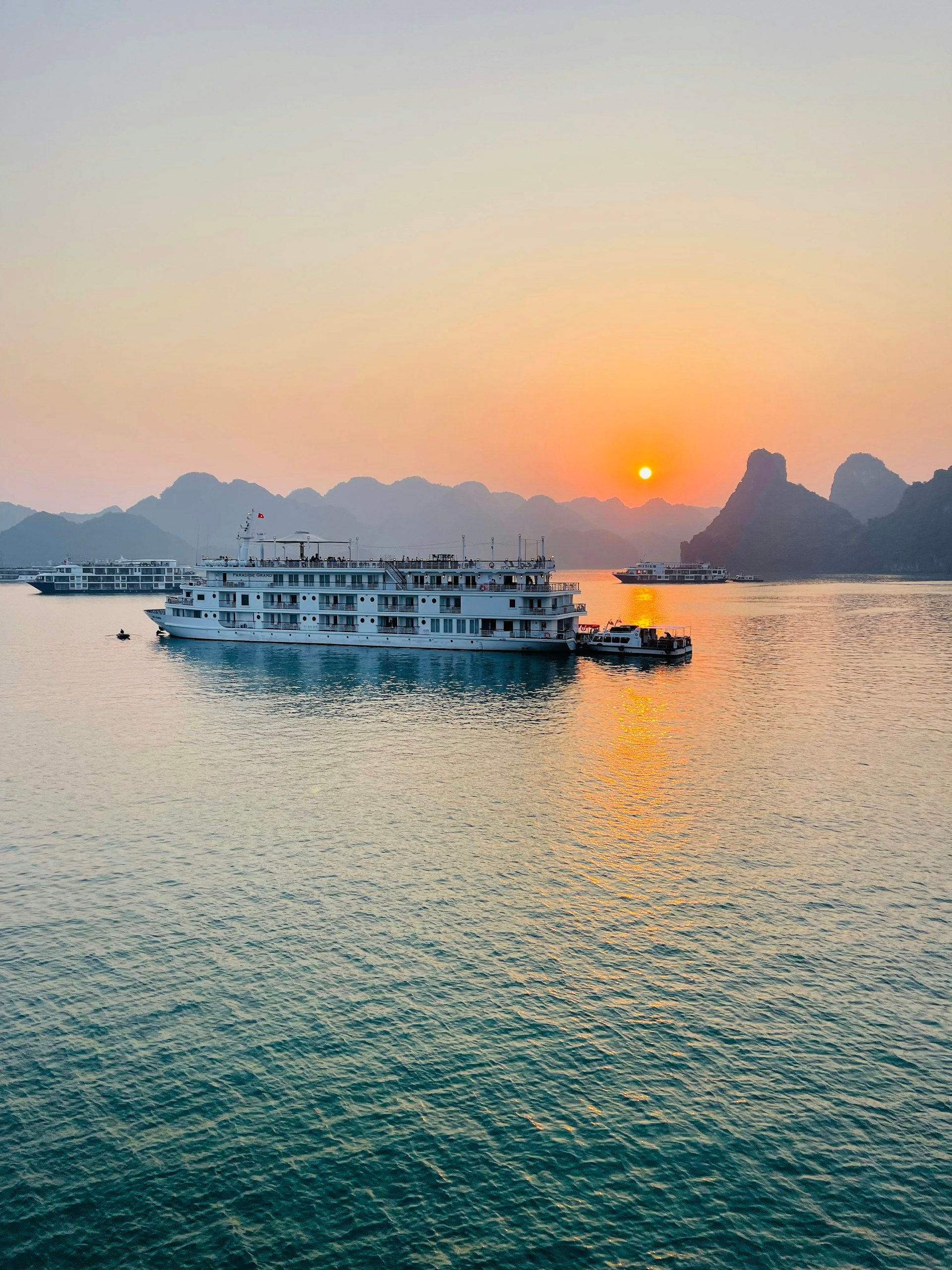
Ha Long Bay is the postcard of Vietnam: nearly 2,000 limestone islands and pinnacles rising from the emerald water of the Gulf of Tonkin, with hidden caves, floating fishing villages and quiet lagoons between them. Since 2023 the bay and the neighbouring Cat Ba archipelago have formed a single UNESCO World Heritage site, and the best way to see them is still from the deck of a boat, ideally with a night on board.
Choosing a cruise is where it gets confusing. Hundreds of boats sail from the same harbours, prices range from a few dozen to several hundred dollars, and every listing promises the “best” route. This guide cuts through it: which bay to choose, how long to go for, what a cruise really costs in 2026, how to get there from Hanoi, what changed for safety after the accidents of 2025 and 2026, and how to pick a good boat.
In this guide14 sections
- —The short answer
- —Ha Long, Lan Ha or Bai Tu Long?
- —Day trip, one night or two?
- —What a Ha Long Bay cruise costs in 2026
- —Getting there from Hanoi
- —A typical two-day cruise
- —The main sights on a cruise
- —What to pack for a cruise
- —Safety: what changed after 2025
- —How to choose the right cruise
- —When to go
- —Where to stay before and after
- —Practical tips
- —Frequently asked questions
The short answer
- Best for most first-timers: a two-day, one-night cruise into Lan Ha Bay or the quieter parts of Ha Long Bay, on a well-reviewed four- or five-star boat.
- Short on time: a day cruise works, but you will spend more time on the road from Hanoi than on the water.
- For peace and quiet: Bai Tu Long Bay, or a two-night itinerary that reaches the outer islands.
- On a budget: a good three- or four-star overnight cruise is better value than a cheap day trip in bad weather.
- Safety first: choose a licensed overnight cruise from an established operator, with a clear weather and refund policy.
Ha Long, Lan Ha or Bai Tu Long?
The three bays are connected and look similar at first sight, but the experience on board is quite different.
| Bay | Usual departure | Feel | Highlights | Best for |
|---|---|---|---|---|
| Ha Long Bay | Tuan Chau or the Ha Long International Cruise Port | Classic and busiest | Sung Sot Cave, Ti Top Island, Luon Cave | First visits and shorter trips |
| Lan Ha Bay | Tuan Chau, or Cat Ba Island | Quieter, greener, small beaches | Kayaking, Dark and Bright Cave, Viet Hai village | Kayaking, couples, fewer boats |
| Bai Tu Long Bay | Ha Long or Hon Gai | Remote and peaceful | Thien Canh Son Cave, Vung Vieng fishing village | Longer cruises and calm water |
Ha Long Bay
The original and most famous bay is also the busiest. Its central route passes the best-known sights, such as the huge chambers of Sung Sot Cave, the viewpoint on Ti Top Island and the kayaking lagoon at Luon Cave. At peak times you share them with many other boats, but the scenery is spectacular and the distances are short, which makes it ideal for a day trip or a single night.
Lan Ha Bay
Lan Ha Bay lies south of Ha Long Bay, around Cat Ba Island, and belongs to the city of Hai Phong. It has the same limestone scenery with fewer boats, small white-sand beaches and some of the best kayaking in Vietnam, through caves and lagoons such as Dark and Bright Cave. Many of the newer overnight cruises now sail here, often departing from Tuan Chau and crossing into Lan Ha during the day. If you want a quieter experience without going far, this is usually the best choice.
Bai Tu Long Bay
North-east of Ha Long Bay, Bai Tu Long is wilder and much less visited. Cruises here visit Thien Canh Son Cave and the floating village of Vung Vieng, where you can explore by rowing boat with a local guide. Fewer operators sail here, and the itineraries suit travellers who value silence over a list of famous sights.
Day trip, one night or two?
| Option | Time on the water | What you see | Typical price per person |
|---|---|---|---|
| Day cruise | 4 to 6 hours | One or two caves or islands, lunch on board | about US$65 to US$120 |
| 2 days, 1 night | about 22 hours | Kayaking, a cave, sunset, cooking class, sunrise tai chi | about US$110 to US$300 |
| 3 days, 2 nights | about 46 hours | Outer islands, villages, a day boat, cycling or beach time | about US$200 to US$550 |
| Luxury cruises | 1 or 2 nights | Suites with balconies, fine dining, a spa | from about US$350 per person per night |
For most travellers, one night is the sweet spot. You board around noon, see the bay in the afternoon light, watch the sunset from the deck, wake up among the islands and are back in Hanoi by mid-afternoon the next day. A day trip is rushed, because the drive from Hanoi takes around five hours return. Two nights make sense if you want the remote outer bays, more time to swim and kayak, or simply a slower holiday.
What a Ha Long Bay cruise costs in 2026
Prices depend on the boat, the cabin, the season and the day of the week. As a guide, expect about US$65 to US$120 per person for a day cruise, about US$110 to US$300 for one night and about US$200 to US$550 for two nights, sharing a double cabin. Luxury ships with large suites and private balconies cost considerably more. Weekends, Vietnamese public holidays and the weeks around Tet, the Lunar New Year, are the most expensive times.
Most overnight cruises include your cabin, all meals on board, the sightseeing fees, kayaking or a bamboo boat ride, an English-speaking guide and activities such as a cooking class or tai chi. Extras usually include drinks, which are expensive on board, the spa, tips and, on many cruises, the shuttle from Hanoi, which typically costs around US$40 to US$50 per person return if it is not included. Solo travellers pay a supplement for a private cabin.
Be careful with comparisons: a “50% off” price is often the normal price, and a cheap cruise that sails only a few hours or keeps you in the busiest part of the bay can be worse value than a slightly more expensive one with a better route.
Getting there from Hanoi
The expressway from Hanoi has made the journey much easier. The drive to Tuan Chau or the Ha Long cruise port takes around two and a half hours, with a short stop on the way. Most cruises offer a shuttle bus or limousine van that collects you from the Old Quarter between about 7.30 and 8.30 am and brings you back by mid-afternoon on your last day. A private car is more comfortable and convenient for families or small groups.
For Lan Ha Bay, some cruises depart from Cat Ba Island, which you reach via Hai Phong. Coming from Ninh Binh, many operators offer direct transfers of around three hours. Van Don International Airport, north of Ha Long, has domestic flights from Ho Chi Minh City and other cities if you want to skip the drive from Hanoi.
If you need a base the night before, our guide to where to stay in Hanoi explains the best areas, and our list of the best things to do in Hanoi will fill your days in the capital.
A typical two-day cruise
Each operator has its own programme, but most one-night cruises follow a similar rhythm.
Day 1
You leave Hanoi in the morning and reach the harbour around noon, where a tender takes you to the ship. Lunch is served as you sail out among the islands. In the afternoon you visit a cave or an island and go kayaking or take a bamboo boat through a lagoon. Back on board, there is a sunset gathering on the sundeck, often a cooking class, then dinner. Some boats offer squid fishing from the deck after dark.
Day 2
Early risers join a tai chi session on the deck at sunrise, followed by coffee and a light breakfast. Many cruises then visit a second cave or a viewpoint before brunch is served on the way back to the harbour. You usually disembark around 10.30 to 11.30 am and are back in Hanoi by mid-afternoon.

The main sights on a cruise
Each route visits only a few of these, so check the itinerary before you book.
- Sung Sot Cave: the “surprise cave”, one of the largest in Ha Long Bay, with vast chambers and rock formations reached by a staircase from the water.
- Ti Top Island: a small beach and a climb of around 400 steps to one of the best viewpoints over the bay, especially at sunset.
- Luon Cave: a low tunnel through the rock that opens into an enclosed lagoon, explored by kayak or bamboo boat, often with monkeys on the cliffs.
- Thien Cung and Dau Go caves: two caves close to the harbour, colourfully lit and usually included on day cruises.
- Dark and Bright Cave: the classic kayaking spot in Lan Ha Bay, where you paddle through a dark passage into a hidden lagoon.
- Ba Trai Dao and the Lan Ha beaches: small sandy coves for swimming when the weather allows.
- Viet Hai village: a quiet village on Cat Ba Island, reached by bicycle or electric cart, on some longer cruises.
- Thien Canh Son Cave and Vung Vieng: the main sights of Bai Tu Long Bay, with a cave above the water and a fishing village explored by rowing boat.
Caves are busiest in the late morning, when day boats arrive from the harbour. Cruises that visit them early or late in the day, or that favour kayaking in quieter lagoons, give a much better experience.
What to pack for a cruise
- Light clothes and a warm layer, as evenings on deck can be cool, especially from November to March.
- Swimwear and quick-dry shoes for kayaking, swimming and wet landings.
- Sun protection, because there is little shade on the sundeck or in the kayaks.
- A small dry bag for your phone and camera on the kayaks.
- Cash in dong for tips and small purchases ashore.
- Any medication you need, as there is no pharmacy on board.
Safety: what changed after 2025
Ha Long Bay is generally a safe place to cruise, but two incidents changed the rules. In July 2025, a sudden thunderstorm capsized the Vinh Xanh 58, a day-tour boat carrying mostly Vietnamese families, and dozens of people died. It was the worst accident in the bay in years. In response, Quang Ninh province required all of the roughly 500 tourist boats on the bay, including overnight cruise ships, to carry automatic identification systems so their position and speed can be tracked in real time, deployed patrol boats and a medical ship around the clock, and tightened the suspension of tours when storms approach.
In February 2026, a fire on a wooden tourist boat carrying foreign visitors led the government to order safety inspections of the entire fleet of overnight cruise ships. Inspections and controls have continued since, especially before holiday peaks. For travellers, the practical lessons are simple:
- Book a licensed overnight cruise from an established operator, through a reputable agency or the operator itself, not a cheap boat sold on the street.
- Check the vessel: many newer ships have steel hulls; ask about fire detection, extinguishers and the safety briefing.
- Know where the life jackets are, and wear one in kayaks and small boats.
- Take the weather seriously: from June to October, storms can cancel or shorten cruises; a good operator reschedules or refunds.
- Buy travel insurance that covers cancellations and medical evacuation.
How to choose the right cruise
- Route first: Lan Ha Bay or Bai Tu Long for fewer boats; the central Ha Long route for the classic sights in a short time.
- Size of the ship: small boats with 10 to 20 cabins feel more personal; large ships offer more facilities.
- Balcony or not: a private balcony is worth paying for in the dry season, much less in winter.
- Recent reviews: read reviews from 2026, focusing on the food, cabin cleanliness and how the crew handled bad weather.
- What is included: transfers, kayaking, cave fees, drinks and tips vary widely between operators.
- The real time on the water: some itineraries spend much of the time moored near the harbour; check the route map.
- Families: check the policy for children and extra beds, and whether the ship has connecting cabins.
When to go
- March to May: warm, calm water and good visibility; one of the best times to cruise.
- June to August: hot and humid, with summer storms and a typhoon risk; very busy with Vietnamese holidaymakers.
- September to November: pleasant temperatures and often clear skies once the storm season fades; October and November are excellent.
- December to February: cool and often misty, with drizzle; atmospheric and cheaper, but chilly on deck and busy around Tet.
Where to stay before and after
Most travellers stay in Hanoi before and after a cruise, usually in the Old Quarter, where the shuttles collect their passengers. If you have an early start or are driving yourself, you can sleep in Ha Long City, around Bai Chay, close to the cruise port. For Lan Ha Bay, Cat Ba Island has hotels and homestays and its own national park. Many itineraries combine Ha Long Bay with Ninh Binh, the inland “Ha Long Bay on land”, two to three hours away.
If you are travelling further south, our guides to where to stay in Da Nang and the best things to do in Hoi An cover central Vietnam.
Practical tips
- Visa: check whether you need an e-visa before you travel; our guide to Vietnam entry requirements explains the rules for 2026.
- Luggage: leave large suitcases at your hotel in Hanoi and bring a small overnight bag; most hotels store luggage for free.
- Drinks: expect to pay restaurant prices on board, and check the policy before you bring your own.
- Seasickness: the bay is sheltered and the water is usually calm, so it is rarely a problem.
- Tips: a tip for the crew, often in an envelope at the end of the cruise, is customary but not compulsory.
- Swimming: only swim where and when the crew allows it.
- Payment: cards are accepted on most ships, but carry some Vietnamese dong for tips and small purchases.
Frequently asked questions
Is a Ha Long Bay cruise worth it?
Yes, if you choose the right route and spend at least one night on board. The scenery is unique, and seeing the bay at sunset and sunrise is very different from a rushed day trip.
Which is better, Ha Long Bay or Lan Ha Bay?
Ha Long Bay has the most famous sights and the shortest distances. Lan Ha Bay has the same scenery with fewer boats, better kayaking and small beaches, so it is usually the better choice for an overnight cruise.
How much does a Ha Long Bay cruise cost?
About US$65 to US$120 per person for a day cruise, US$110 to US$300 for one night and US$200 to US$550 for two nights, sharing a cabin. Luxury cruises cost more.
Is one night enough for Ha Long Bay?
For most travellers, yes. One night gives you an afternoon, a sunset and a morning on the water. Choose two nights if you want the remote outer bays or a slower pace.
How far is Ha Long Bay from Hanoi?
Around two and a half hours by road on the expressway, to Tuan Chau or the Ha Long cruise port.
Is it safe to cruise Ha Long Bay?
Generally yes. Safety rules and controls were tightened after the accidents of 2025 and 2026. Book a licensed overnight cruise with a good reputation, follow the crew’s instructions and accept cancellations when storms approach.
Prices, routes and rules were checked in November 2026 and change often. Confirm the details with your cruise operator when you book.
Newsletter
New stays and deals, once a month
Our latest hotel guides, new destinations and selected partner deals in Southeast Asia. No spam, unsubscribe anytime.