Penang is Malaysia’s food capital and one of the most rewarding cities in Southeast Asia to explore on foot. Its old town, George Town, is a UNESCO World Heritage Site of shophouses, clan houses, mosques, temples and colonial buildings, painted with street art and full of hawker stalls. Beyond the city there is a cool hill station, a national park with quiet beaches, and one of the largest Buddhist temples in the region.
This guide lists the best things to do in Penang in 2026, with prices where they matter, tips on what to eat and where, and the practical details for the trip: the free digital arrival card, how to get from the airport and the tourism tax on hotels. It ends with sample plans for two and three days.
In this guide26 sections
- —Before you go: what to know in 2026
- 01Walk the streets of George Town
- 02Hunt for street art
- 03Visit the clan houses and the Clan Jetties
- 04Tour the Blue Mansion and the Peranakan Mansion
- 05Eat your way through Penang’s hawker food
- 06Explore Little India
- 07Ride the funicular up Penang Hill
- 08See Kek Lok Si Temple
- 09Hike in Penang National Park
- 10Spend an evening in Batu Ferringhi
- 11Visit the Tropical Spice Garden and the Botanic Gardens
- 12Learn the city’s history
- 13Discover the café and art scene
- 14Time your trip with a festival
- 15Take the family to Teluk Bahang
- 16Plan a hawker crawl
- —Money and costs
- —Getting from Penang to other destinations
- —Sample itineraries
- —When to go
- —Getting there and around
- —Where to stay
- —Practical tips
- —Staying safe and comfortable
- —Frequently asked questions
Before you go: what to know in 2026
- Digital arrival card. Almost all foreign visitors must fill in the free Malaysia Digital Arrival Card (MDAC) online in the three days before arriving, on the Immigration Department’s official site. Citizens of Singapore are among the few exemptions. Ignore websites that charge a fee.
- Tourism tax. Foreign guests pay a tourism tax of RM10 per room per night in most hotels, usually collected at check-in or check-out.
- Visit Malaysia 2026. The national tourism year means more events and festivals, and busier weekends.
- Getting in. Penang International Airport is about 30 to 45 minutes by car from George Town.
01Walk the streets of George Town
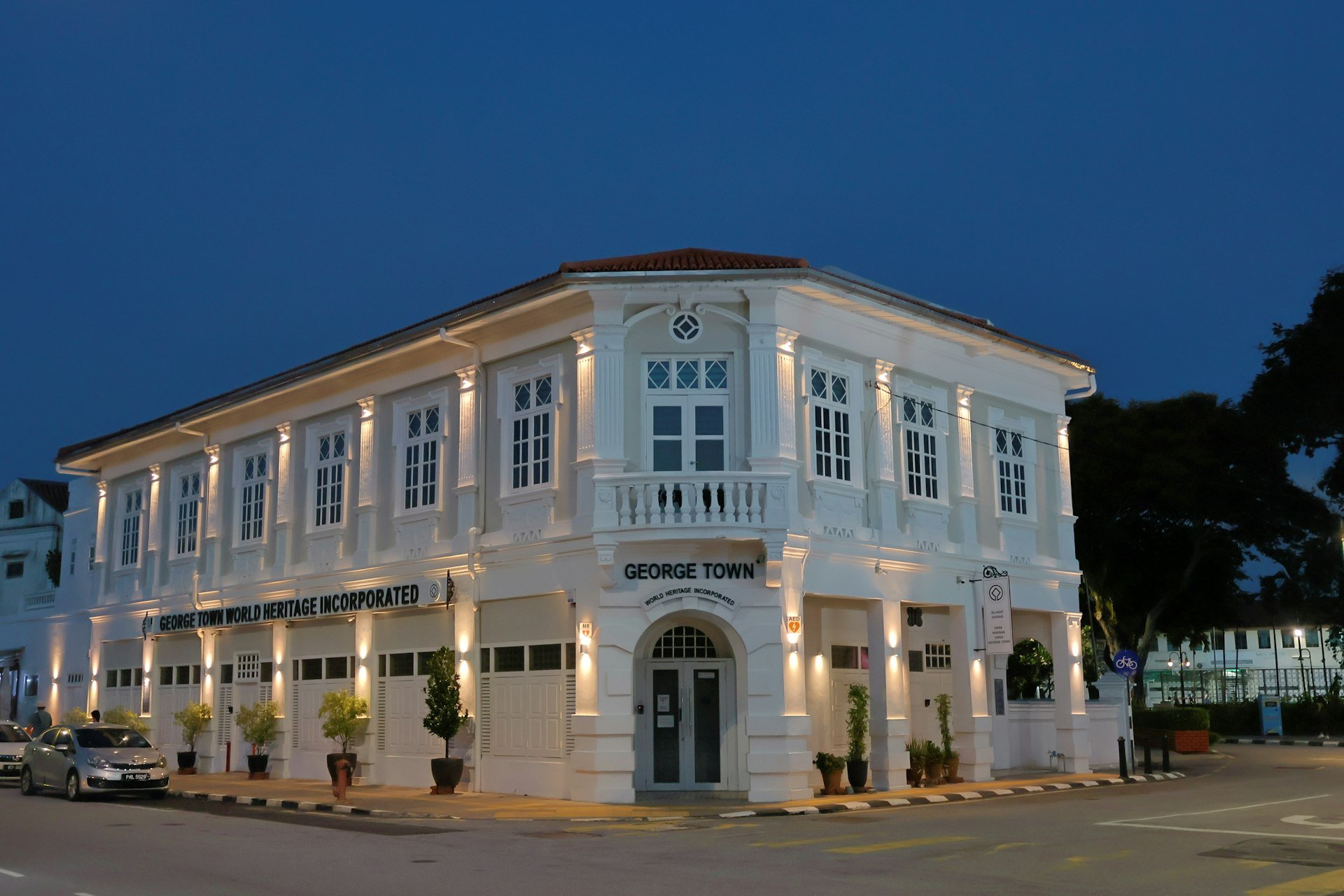
George Town became a UNESCO World Heritage Site in 2008, together with Melaka, for its multicultural trading-port heritage. The best way to see it is on foot, early in the morning or late in the afternoon when it is cooler. Wander along Armenian Street, Lebuh Chulia, Love Lane and Lebuh Acheh, where Chinese shophouses, Indian Muslim mosques, Hindu temples and colonial offices stand side by side. The area is compact, but the heat is real; plan a café stop every hour.
02Hunt for street art
In 2012, the artist Ernest Zacharevic painted a series of murals in George Town, including the much-photographed Children on a Bicycle on Armenian Street, where a real bicycle is attached to the wall. Since then, dozens of murals and iron-wire caricatures have appeared across the old town, telling stories about the city’s history and trades. Pick up a street-art map or simply wander; many of the best pieces are in quiet back lanes. Go early to photograph the famous ones without a queue.
03Visit the clan houses and the Clan Jetties
Chinese clan associations built grand temples and meeting halls in George Town. Khoo Kongsi, hidden in a courtyard off Cannon Square, is the most spectacular, with a richly carved and gilded temple, a theatre and a small museum. Down by the waterfront, the Clan Jetties are wooden villages on stilts, each built by a different Chinese clan. Chew Jetty is the largest and the most visited; remember that people live here, so keep noise down and respect private homes.
04Tour the Blue Mansion and the Peranakan Mansion
The Cheong Fatt Tze Mansion, known as the Blue Mansion for its indigo walls, was built in the late 19th century for a wealthy Chinese merchant and is now a heritage hotel. Guided tours explain its feng shui design and restoration. The Pinang Peranakan Mansion is a lavish green house filled with the furniture, porcelain and jewellery of the Peranakan (Straits Chinese) community. Both are among the best museums in Malaysia.
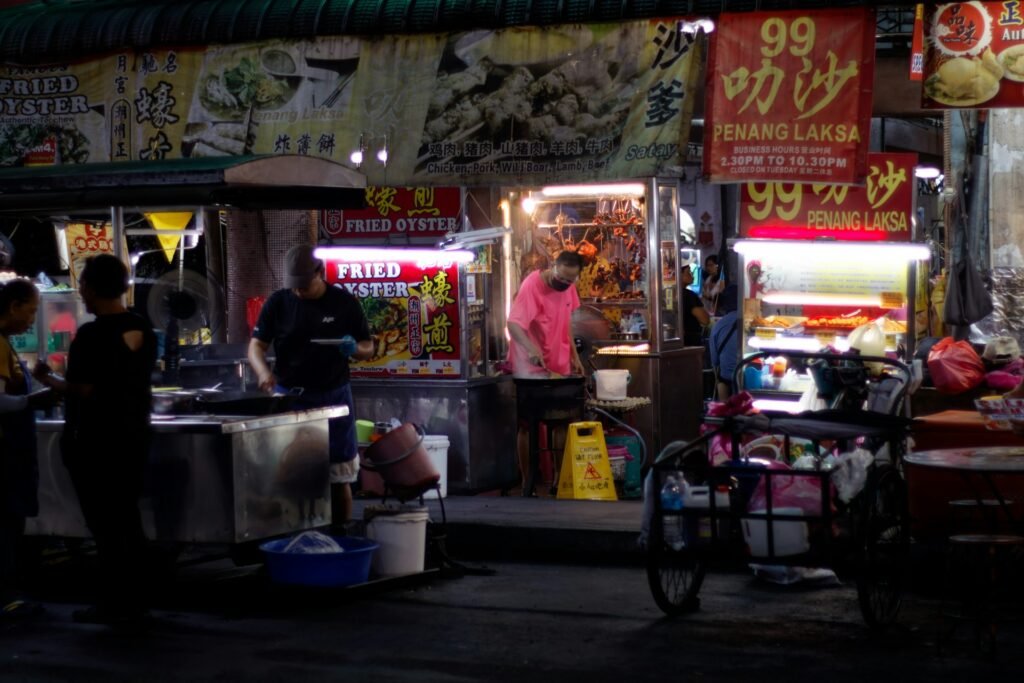
05Eat your way through Penang’s hawker food
Penang’s hawker food is the main reason many people come. Eat at hawker centres and street stalls, where most dishes cost a few ringgit:
- Char kway teow: flat rice noodles stir-fried in a smoking wok with prawns, cockles, egg and bean sprouts.
- Assam laksa: a sour, spicy fish broth with thick rice noodles, mint, pineapple and shrimp paste, the dish most associated with Penang.
- Nasi kandar: rice with a choice of rich curries, fried chicken and vegetables, a Tamil Muslim tradition.
- Hokkien mee: noodles in a deep prawn and pork broth.
- Cendol: shaved ice with green rice-flour jelly, palm sugar and coconut milk, perfect in the heat.
- Roti canai and teh tarik: flaky flatbread with curry, and “pulled” sweet tea, for breakfast.
Popular places to eat include the hawker stalls of Gurney Drive, New Lane, Chulia Street at night and the Kimberley Street night stalls. The best stalls have queues of locals; join them.
06Explore Little India
Around Lebuh Pasar and Lebuh Queen, Little India smells of spices, jasmine garlands and frying snacks. Visit the Sri Mahamariamman Temple, the oldest Hindu temple in Penang, and eat a banana-leaf meal or a thali. In the same area, the Kapitan Keling Mosque, built by Indian Muslim traders, is open to respectfully dressed visitors outside prayer times.
07Ride the funicular up Penang Hill
Penang Hill (Bukit Bendera), the oldest British hill station in the region, rises to over 800 m above George Town. A funicular railway climbs to the top in a few minutes, through a steep tunnel. In 2026, return fares for non-Malaysian adults were around RM30, with a more expensive fast lane to skip the queue at busy times. At the top, it is several degrees cooler, with viewpoints over the island and the mainland, colonial bungalows, a mosque and a Hindu temple. The Habitat, a nature park at the summit, has a canopy walk and a treetop walkway with wide views. Go on a weekday morning, or stay for the city lights at dusk.
08See Kek Lok Si Temple
At the foot of Penang Hill in Air Itam, Kek Lok Si is one of the largest Buddhist temple complexes in Southeast Asia, built from the late 19th century onwards. Its seven-storey pagoda mixes Chinese, Thai and Burmese styles, and a giant bronze statue of Kuan Yin, the Goddess of Mercy, stands on the hill above. Entry to the main temple is free, with small fees for the pagoda and the inclined lift to the statue. Around Chinese New Year, the temple is lit with thousands of lanterns. It is easy to combine with Penang Hill on the same day.
09Hike in Penang National Park
On the north-west tip of the island, Penang National Park is one of the smallest national parks in the world, with rainforest trails leading to quiet beaches. Register at the park office at Teluk Bahang, then walk to Monkey Beach or Turtle Beach (Pantai Kerachut), where a conservation centre protects nesting sea turtles. Some visitors walk one way and take a boat back. Carry water, start early and watch for monkeys around your food.
10Spend an evening in Batu Ferringhi
Batu Ferringhi is Penang’s main beach resort strip on the north coast, with large hotels, water sports and a busy night market selling clothes, souvenirs and snacks. The beach is better for sunsets and walks than for swimming, as the water is not as clear as on Malaysia’s east coast islands. It is a good base for families who want a pool and a beach.
11Visit the Tropical Spice Garden and the Botanic Gardens
The Tropical Spice Garden, on the coast road near Teluk Bahang, is a landscaped hillside of spices, herbs and tropical plants, with a cooking school. Closer to town, the Penang Botanic Gardens, dating from the British period, are free and popular with joggers and families, and the start of a hiking trail up Penang Hill.
12Learn the city’s history
Fort Cornwallis, on the site where Captain Francis Light landed in 1786 to establish a British trading post, has walls, cannons and a small exhibition. The Penang State Museum and the old City Hall area along the Esplanade tell the story of the colony, and the waterfront is pleasant at sunset.
13Discover the café and art scene
George Town has excellent independent cafés in restored shophouses, as well as galleries, design shops and the Hin Bus Depot, a former bus garage turned arts space with exhibitions, a weekend market and street art. It is a good way to see the creative, modern side of the city.
14Time your trip with a festival
Penang’s calendar is full of festivals from all its communities. Chinese New Year and the lantern-lit Chap Goh Meh fill the streets with lion dances and food. Thaipusam, in January or February, brings a huge Hindu procession to the Waterfall Hilltop Temple. The George Town Festival of arts, held around the middle of the year, and the Penang Hill Festival, held on 17 to 19 July in 2026, add music and exhibitions. Check dates before you book, as hotels fill quickly.
15Take the family to Teluk Bahang
The north-west corner of the island has good options for families. ESCAPE Penang is an outdoor adventure and water park with ropes courses, ziplines and long water slides, and Entopia, the butterfly and insect park run by the Penang Butterfly Farm, has a large tropical garden and indoor exhibits. Both are easy to combine with the national park or the Tropical Spice Garden.
16Plan a hawker crawl
The best way to eat in Penang is to graze: one or two dishes at each stop, shared between friends. A simple evening plan in George Town starts with assam laksa or char kway teow at a hawker centre, continues with satay or nasi kandar, and ends with cendol or an ice kacang. Locals often eat one dish per stall and move on. Many of the most famous stalls open only at certain times or close one day a week, so check before you go, and be ready to queue. Ask your hotel which stalls are open that day; it changes often.
Money and costs
Penang is good value by regional standards. Hawker dishes usually cost a few ringgit, a coffee in a heritage café more, and a meal in a restaurant considerably more. Heritage boutique hotels in George Town range from simple guesthouses to restored mansions. Cards and QR payments are widely accepted, but carry cash for hawker stalls, markets and small shops. ATMs are easy to find in George Town and Batu Ferringhi.
Getting from Penang to other destinations
Penang is an easy stop on a longer trip. From George Town you can fly or take a ferry to Langkawi, catch the ETS train south to Ipoh and Kuala Lumpur, or fly to Singapore, Bangkok and other Asian cities. Many travellers combine Penang with Langkawi’s beaches or with the Cameron Highlands, which is a few hours away by road. If you are coming from Thailand, remember that Malaysia and Thailand have different arrival cards: Malaysia’s MDAC and Thailand’s TDAC are both filled in online before travel.
Sample itineraries
Two days
- Day 1: George Town on foot: street art, Khoo Kongsi, the Clan Jetties, Little India and the Blue Mansion tour; hawker dinner on Chulia Street.
- Day 2: Kek Lok Si in the morning, Penang Hill for lunch and The Habitat, back down for sunset and dinner at Gurney Drive.
Three days
Add a day in the north-west: Penang National Park in the morning, the Tropical Spice Garden, and the Batu Ferringhi night market in the evening.
When to go
Penang is hot and humid all year, between about 24°C and 32°C. The driest months are usually December to February, which is also high season and Chinese New Year time. From about April to October, afternoon showers are common, and September and October are often the wettest months. Rain usually comes in short, heavy bursts, so it rarely ruins a whole day.
Getting there and around
Penang International Airport has flights from Kuala Lumpur, Singapore, Bangkok and other Asian cities. Taxis and ride-hailing cars take about 30 to 45 minutes to George Town. From Kuala Lumpur, the ETS train runs to Butterworth on the mainland, from where a short ferry crosses to George Town; driving takes about four to five hours. In George Town, walk, use ride-hailing apps or take the free CAT bus around the heritage area. For the national park and Batu Ferringhi, use a ride-hailing car or the Rapid Penang buses.
Where to stay
Stay in George Town for heritage boutique hotels and food on your doorstep, or in Batu Ferringhi for a beach resort. Our guide to where to stay in Penang compares the areas, and our selection of the best boutique hotels in Penang lists our favourite heritage stays. If you are continuing to the islands, see where to stay in Langkawi.
Practical tips
- Dress modestly in mosques and temples; robes are often provided at the Kapitan Keling Mosque.
- Carry cash for hawker stalls, although many now accept QR payments.
- Drink plenty of water and plan breaks in air-conditioned museums or cafés.
- Book the Blue Mansion tour ahead in high season.
- Respect residents in the Clan Jetties and heritage lanes.
Staying safe and comfortable
Penang is a safe city for visitors, and the main risks are the heat, the traffic and the occasional bag snatching on busy roads. Keep your bag on the side away from the road, use pedestrian crossings, drink plenty of water and wear sun protection. Mosquitoes can carry dengue, so use repellent, especially at dawn and dusk. In the hills and the national park, stay on marked trails and keep food away from monkeys.
Flying in or out through the capital? Our guide to the best things to do in Kuala Lumpur has ideas for one to three days in the city.
Frequently asked questions
How many days do you need in Penang?
Two days covers George Town, Penang Hill and Kek Lok Si. Three days lets you add the national park and the north coast.
What is Penang famous for?
Its hawker food, the UNESCO-listed old town of George Town, its street art and its mix of Chinese, Malay, Indian and colonial heritage.
How much is the Penang Hill funicular for tourists?
In 2026, a return ticket for non-Malaysian adults was around RM30, with fast-lane tickets costing more.
Do I need the MDAC to enter Malaysia?
Almost all foreign visitors must complete the free Malaysia Digital Arrival Card online within three days before arrival. Citizens of Singapore are exempt.
Is Penang good for beaches?
Penang has pleasant beaches at Batu Ferringhi and in the national park, but if a beach holiday is your main goal, Langkawi is a better choice.
When is the best time to visit Penang?
December to February is usually driest. Penang can be visited all year, with short tropical showers in the wetter months.
Prices, opening hours and entry rules were checked in November 2026 and may change. Confirm the latest details before you travel.
Newsletter
New stays and deals, once a month
Our latest hotel guides, new destinations and selected partner deals in Southeast Asia. No spam, unsubscribe anytime.