“How much does it cost to build a villa in Bali?” is one of the first questions every foreign buyer asks, and the answers online range from US$300 to more than US$2,500 per square metre. Both numbers can be right. The difference comes from the finish level, the location, who manages the build and what is actually included in the quote.
We are based on Lombok and work with buyers, builders and investors in Lombok and Bali. This guide explains what a villa really costs to build in 2026, line by line: construction per square metre, design, permits, the pool, furniture, contingency, and the land lease that comes before all of it. It also shows how Lombok compares with Bali, and the mistakes that push budgets over.
This article is general information, not legal, tax or financial advice. Prices are indicative ranges from builders and market reports in 2026; get written quotes for your own project.
In this guide15 sections
- —The short answer
- —What drives the price
- —A worked example: a three-bedroom pool villa
- —Permits: PBG and SLF
- —Land: lease costs and new rules in Bali
- —Lombok compared with Bali
- —Build or buy?
- —How long does it take?
- —Payment schedules and contracts
- —Mistakes that blow the budget
- —Running costs to budget every year
- —Questions to ask a builder before you sign
- —Is it a good investment?
- —How we can help
- —Frequently asked questions
The short answer
In 2026, most builders and market reports put construction costs for a villa in Bali roughly in these bands, per square metre of built area:
| Finish level | Typical 2026 range per m² | What you get |
|---|---|---|
| Local standard | About IDR 5 to 8 million (roughly US$300 to 500) | Simple design, local materials, basic fittings, often built for local rentals or staff housing |
| Mid-range | About US$850 to 1,100 | Good-quality materials, modern tropical design, suitable for holiday rentals |
| Premium | About US$1,200 to 1,600 | Architect-designed, better glazing, waterproofing and fittings |
| Luxury | US$1,800 to 2,500 and more | Signature architecture, imported materials, complex structures, cliff or rice-field sites |
These figures usually cover the building itself. The pool, landscaping, furniture, design fees, permits and a contingency are often extra, and together they can add 30 to 50% to the total. Land, or more often a long-term land lease, comes on top.

What drives the price
1. Finish level and materials
The single biggest factor is the specification: the quality of the roof, windows, doors, waterproofing, bathrooms and kitchen. Locally sourced timber, stone and terrazzo can look superb and keep costs down. Imported tiles, large aluminium sliding doors, branded sanitary ware and air-conditioning systems push them up quickly. Builders in Bali reported material prices rising by around 5 to 7% a year, so a quote from 2024 is not a reliable guide today.
2. The site
A flat, accessible plot near a paved road is the cheapest to build on. Sloping plots, cliff tops, rice fields with soft ground and sites reachable only on foot need retaining walls, deeper foundations, drainage or manual transport of materials. Each can add a significant amount before a single wall goes up. Ask for a soil test and a survey before you sign a lease.
3. Design complexity
Large spans, cantilevers, open-sided living areas, roof gardens and infinity pools all need more engineering, more steel and better workmanship. A simple rectangular plan with a standard roof is far cheaper per square metre than a sculptural design of the same size.
4. Who manages the build
Owners who hire a design-and-build company pay a margin but get one contract and one responsible party. Owners who hire an architect and then tender the construction separately often get better prices, but they need a strong project manager on site. Architects and project managers usually charge around 5 to 10% of the construction value, and a full-time site manager costs roughly IDR 5 to 15 million a month in 2026.
5. Location
Labour, transport and land prices vary across Bali. Canggu, Pererenan, Uluwatu and Seminyak are the most expensive. Tabanan, the north and east coasts are cheaper but further from the rental market. Lombok is different again; see below.
A worked example: a three-bedroom pool villa
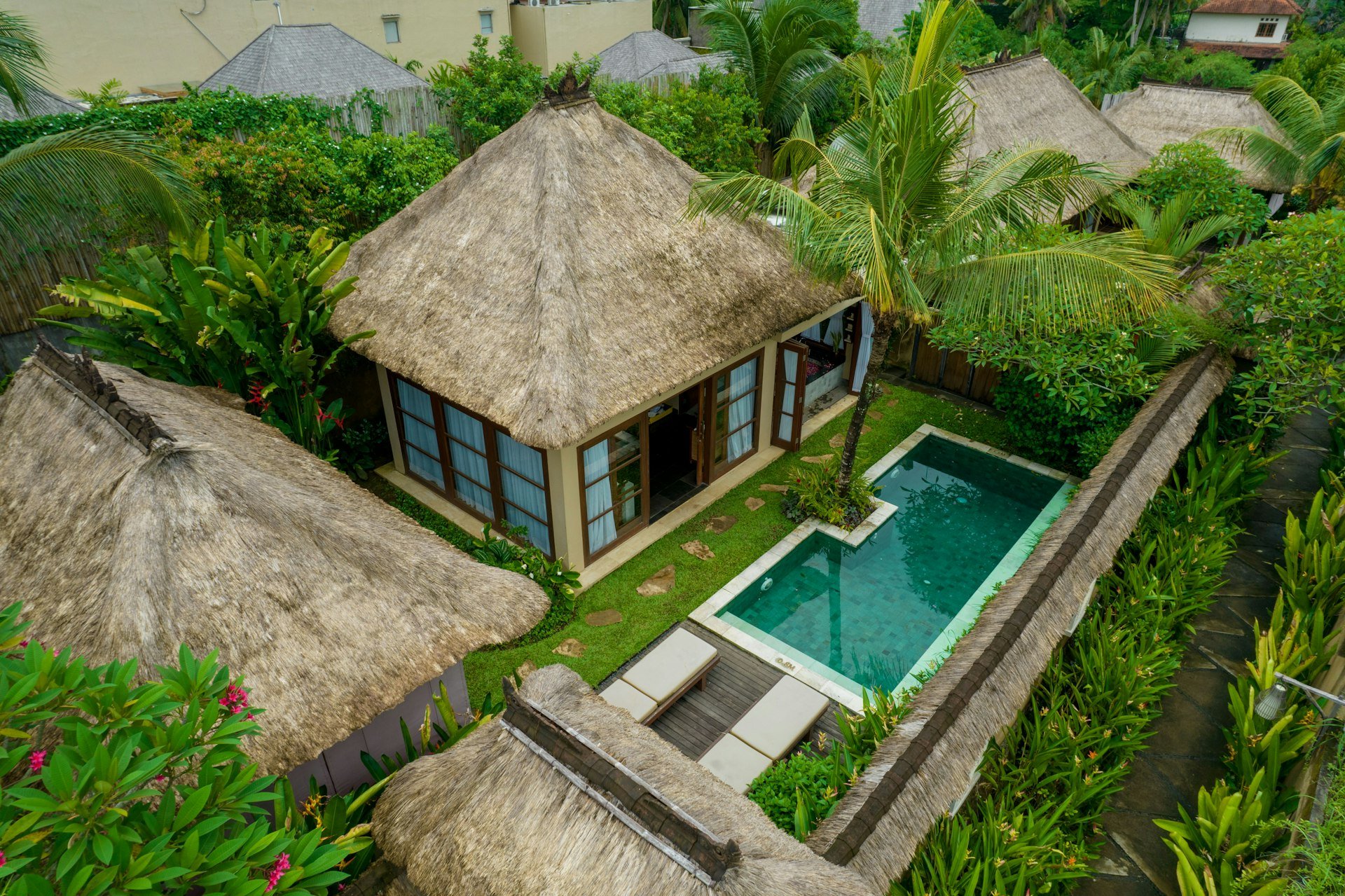
To make the numbers concrete, here is an illustrative budget for a mid-range three-bedroom villa with a built area of 200 m² and a 4 x 8 m pool. The prices are examples within the 2026 ranges above, not a quote.
| Line | Assumption | Example budget (US$) |
|---|---|---|
| Construction | 200 m² x US$1,000 | 200,000 |
| Pool and decking | Simple concrete pool with filtration | 20,000 to 30,000 |
| Landscaping, walls and gate | Garden, boundary wall, parking | 10,000 to 20,000 |
| Design and engineering | Around 5 to 8% of construction | 10,000 to 16,000 |
| Project management | Site manager for 10 months | 3,000 to 9,000 |
| Permits and utilities | Building approval, power, water connection | Varies by regency |
| Furniture, fittings and equipment | Beds, sofas, kitchen, linen, decor | 20,000 to 35,000 |
| Contingency | 10 to 15% of the above | 26,000 to 47,000 |
| Total before land | Before land lease | About 290,000 to 360,000 |
The same villa at a local-standard specification could cost well under half of this; at a premium specification it could cost much more. What matters is that every line is in your budget from day one. Most overruns come from lines that were never budgeted, not from construction itself.
Permits: PBG and SLF
Since 2021, the old building permit (IMB) has been replaced by the PBG (Persetujuan Bangunan Gedung, building approval), applied for online through the government’s SIMBG system, and the SLF (Sertifikat Laik Fungsi, certificate of fitness for use), issued when the building is finished. The PBG is based on approved drawings, structural calculations and a site plan that matches the land’s zoning.
Three points matter for foreign owners:
- Zoning comes first. Before you lease land, check that its zoning allows the building you want, especially if you plan to rent it to tourists. Not all land in green or agricultural zones can be built on.
- The permit holder matters. The PBG is issued to whoever has the right to build on the land, which is usually the leaseholder or your company. This must match your legal structure. Our guide to leasehold, Hak Pakai and PT PMA explains the options.
- Rental licences are separate. Renting a villa to tourists needs its own business registration and licence. Read our article on Bali villa rental rules in 2026 before you plan your income.
Land: lease costs and new rules in Bali
Most foreigners do not buy freehold land in Indonesia; they lease it, usually for 25 to 30 years, sometimes with extension options. In high-demand parts of Bali, 2026 leasehold prices of roughly IDR 20 to 55 million per are (100 m²) per year of lease were reported. For a 500 m² plot on a 25-year lease, that can mean a substantial upfront payment before construction starts.
Bali has also tightened its rules on land. Since September 2025, a gubernatorial decree has restricted the conversion of productive farmland, including rice fields, for tourism and commercial building, and the restriction is being applied in more regencies from 2026. In practice, a plot that looks perfect in the middle of rice fields may no longer be buildable for a villa. Check the zoning and the current local rules with a notary and the land office before paying anything.
Lombok compared with Bali
Lombok attracts buyers who find Bali too crowded or too expensive. The differences that matter for a build are:
- Land and leases are generally much cheaper than in south Bali, especially away from Kuta and the Mandalika development.
- Labour costs are often lower, but there are fewer experienced contractors and architects used to international standards, so choosing the team matters even more.
- Materials such as imported fittings, glass and some finishes often come from Bali or Java, which adds transport costs and time.
- The rental market is smaller and more seasonal. The Mandalika circuit and new hotels have brought more visitors, but you should plan occupancy prudently.
- Infrastructure varies widely: some plots have no paved road, mains water or stable power yet.
For context, off-plan one-bedroom villas in the Kuta area of Lombok were advertised in 2026 at around IDR 2.25 billion on a 28-year lease. For a deeper look at the legal side, read our guide to buying land in Lombok as a foreigner.
Build or buy?
Building lets you choose the design and, in theory, costs less per square metre than buying a finished villa. In Bali, market reports for the first half of 2026 put the average asking price for villas at around US$1,975 per m². Building at a mid-range specification can come in below that, but you take the risks of delays, overruns and managing contractors yourself, and you wait a year or more before any rental income.
- Build if you have time, a trusted team on the ground and a clear design, and you plan to own the villa for many years.
- Buy if you want income sooner, prefer a finished product you can inspect, or cannot be on site regularly.
- Off-plan sits in between: lower prices, but you depend on the developer finishing on time. Check their track record and payment schedule carefully.
How long does it take?
A mid-range villa usually takes 8 to 12 months to build once permits are in place. Add one to three months for design and the PBG, and allow for the rainy season from about November to March, which slows earthworks and roofing. Ceremonies, public holidays and Nyepi also pause work in Bali. A realistic total from signing the lease to the first guest is often 12 to 18 months.
Payment schedules and contracts
- Never pay most of the price up front. Pay by stages linked to completed work: foundations, structure, roof, finishes, handover.
- Get a fixed-price contract with a detailed bill of quantities, listing materials, brands and quantities, so changes can be priced fairly.
- Keep a retention of 5 to 10% until the end of a defects period after handover.
- Write the schedule into the contract, with clear consequences for delays.
- Use an independent inspector or project manager if you cannot be on site.
- Have the contract reviewed by a lawyer or notary who knows construction in Indonesia, in a language you understand.
Mistakes that blow the budget
- Signing a land lease before checking zoning and access. A plot that cannot get a PBG is worth very little.
- Comparing quotes that do not include the same things. One builder’s “per m²” may include the pool and the kitchen; another’s may not.
- Changing the design during construction. Every change costs time and money, and often more than you think.
- Forgetting waterproofing and drainage. Tropical rain will find any weakness. Pay for good roofs, membranes and gutters.
- Skipping the contingency. Ten to fifteen per cent is not padding; it is what keeps the project finished.
- Underestimating running costs. Pool maintenance, staff, electricity, internet, repairs and rental platform fees all reduce your net return.
Running costs to budget every year
Building is a one-off cost; running the villa is permanent. Owners are often surprised by how much these lines add up to, so plan them before you decide on the size and design.
- Staff: a housekeeper, a gardener and often a pool cleaner, with wages, a holiday bonus and insurance as required by Indonesian law.
- Utilities: electricity is the largest bill in a villa with air-conditioning and a pool pump; solar panels can reduce it. Water, gas and internet come on top.
- Maintenance: tropical humidity, salt air and heavy rain wear materials faster than in cooler climates. Budget a fixed share of the construction cost each year for painting, sealing, roof checks and replacing fittings.
- Pool: chemicals, cleaning and occasional pump and filter repairs.
- Management: if you rent the villa out, a manager or agency usually takes a percentage of revenue, plus booking platform commissions.
- Taxes and licences: local taxes on rental income and the yearly cost of keeping your licences in order.
Questions to ask a builder before you sign
- Can I see three villas you have finished in the last two years, and speak to their owners?
- Who will be on site every day, and how often will I receive photos and progress reports?
- What exactly is included in your price per square metre? Pool, kitchen, air-conditioning, electrical fittings, landscaping?
- Which brands and grades of roof, waterproofing, windows and sanitary ware are in the quote?
- How do you price changes, and how are they approved?
- What is your payment schedule, and what retention do you accept?
- What warranty do you give on the structure, the roof and waterproofing?
- Do you handle the PBG application, and who is responsible if it is delayed?
A builder who answers clearly and in writing is worth a slightly higher price. One who is vague about what is included will usually make up the difference later.
Is it a good investment?
A villa can be a rewarding investment, but only when the numbers work without optimistic assumptions. Start from realistic nightly rates and occupancy for your area, subtract management fees (often 15 to 25% of revenue in Bali), staff, utilities, maintenance, taxes and the cost of your lease spread over its term. Remember that a leasehold villa loses value as the lease runs down, unless you have a clear right to extend. Our investment resources and calculator help you test the numbers.
How we can help
Trioffe Hospitality is based in Lombok and helps buyers and owners structure projects, find land and partners, and check budgets before they commit. If you are planning a build in Lombok or Bali, tell us about your project on our property page or book a consultation.
Will it pay off? Read our guide to realistic Bali villa rental yields in 2026 before you commit to a build.
Frequently asked questions
How much does it cost to build a villa in Bali per square metre in 2026?
Typical ranges were about IDR 5 to 8 million per m² for local-standard builds, about US$850 to 1,100 for mid-range, US$1,200 to 1,600 for premium and US$1,800 to 2,500 or more for luxury, before land, pool, furniture and fees.
Is it cheaper to build in Lombok than in Bali?
Land and labour are usually cheaper on Lombok, but some materials cost more to bring in and there are fewer experienced builders, so the saving depends on the project.
How long does it take to build a villa in Bali?
Usually 8 to 12 months of construction, plus design and permits. From lease to first guest, 12 to 18 months is realistic.
Can a foreigner build a villa in Indonesia?
Foreigners usually build on leased land or through an Indonesian foreign-investment company (PT PMA). The right structure depends on your plans; read our guide or ask a qualified notary.
What permits do I need?
A PBG (building approval) before construction and an SLF (certificate of fitness for use) when it is finished, plus separate licences if you rent the villa to tourists.
How much contingency should I keep?
At least 10 to 15% of the construction and fit-out budget.
Figures are indicative 2026 ranges from builders and market reports and change with exchange rates and material prices. Always obtain written quotes and independent legal advice for your own project.
Newsletter
New stays and deals, once a month
Our latest hotel guides, new destinations and selected partner deals in Southeast Asia. No spam, unsubscribe anytime.